
Easy to Use FM Radio Receiver


The project is a user-friendly and cheap FM radio receiver which produces the desired audio signals using integrated circuit to achieve the pre-processing units. During operation, the user is allowed to change stations and interact with the receiver by integrating a keypad and an LCD for communication. There are several functions that this radio receiver can perform including adjusting the threshold when picking up stronger or weaker stations, setting up 3 favorite stations for quick tuning, scanning up/down for next strong signal station, and tuning up/down a frequency.
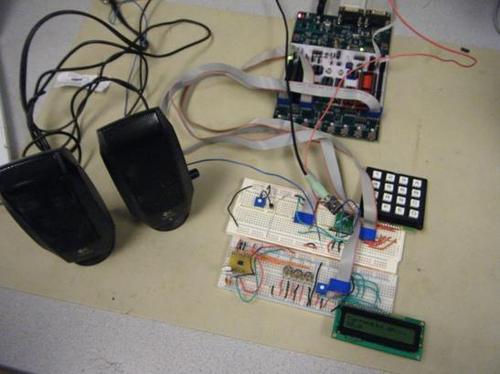
Hacks and Mods:Easy-To-Use FM Radio Receiver

A keypad is designed for controlling the receiver and the buttons are mapped to their corresponding functionality while the other buttons are not connected. The 4 main sub-components of the receiver include the LCD, the keypad, the favorite station storage, and the communication with receiver. Each of them is being controlled by their software components. The antenna transfers the incoming radio signal to the AR1010 FM radio receiver. To communicate with the AR1010, the I2C protocol is used since the sample code is available online. Also, the AR1010 is powered by 3V. The button presses on the keypad are scanned by the program.

Comments

Popular posts from this blog

A basic Arduino Solar PV Monitor

I have just recently had solar pv installed, mainly to future proof my energy costs, I do not expect it to be like drilling for oil in my back garden, however the return looks to be encouraging. The install gives you another single unit meter, from this you will see the total amount the panels produce, but that is about it. I wanted to know how much the production was as it was happening, I discovered the light blinks on the front of the meter will flash 1000 times for each kWh of electricity which passes through. The rate of the flashing of the LED tells you how much power is currently passing through the meter. [ ]

Build a Key Operated Gate Locking System Circuit

This simple key-operated gate locking system allows only those persons who know the preset code to open the gate. The code is to be entered from the keypad within the preset time to operate the motor fitted in the gate. If anyone trying to open the gate presses a wrong key in the keypad, the system is disabled and, at the same time, sounds an alarm to alert you of an unauthorized entry. Figs 1 and 2 show the block and circuit diagrams of the key-operated code locking system, respectively. Connect points A, B, C, D, E, F and ground of the circuit to the respective points of the keypad. Keys S7, S16, S14 and S3 are used here for code entry, and the remaining keys are used for disabling the system. It is very important to press the keys in that order to form the code. To start the motor of the gate, press switches S7, S16, S14 and S3 sequentially. If the keys are pressed in a different order from the preset order, the system will lock automatically and the motor will not start. Fig. 1: Bl...

Simple But Automatic Load Sensing Power Switch

This circuit will automatically switch on several mains-powered "slave" loads when a "master" load is turned on. For example, it will switch on the amplifier and CD player in a stereo system when the receiver is turned on. It works by sensing the current draw of the "master" device through a low value high wattage resistor using a comparator. The output of that comparator then switches on the "slave" relay. The circuit can be built into a power bar, extension cord or power center to provide a convenient set of "smart" outlets that switch on when the master appliance is powered (turn on the computer monitor and the computer, printer and other peripherals come on as well). Automatic Load Sensing Power Switch Circuit Diagram Parts List: Notes: This circuit is designed for 120V operation. For 240V operation, resistors R2 and R6 will need to be changed. A maximum of 5A can be used as the master unless the wattage of R1 is increased S1 provid...